



 Contact Us
A long-established company excelling in niche areas with technical prowess and world-first development capabilities
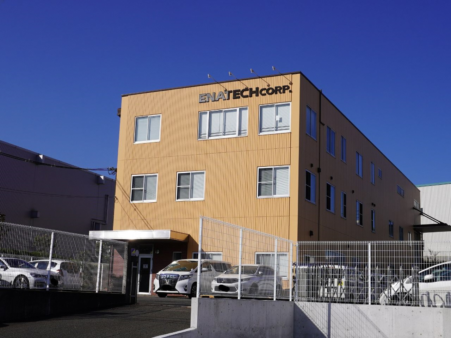
Updated: March 31, 2026

2025
Updated: March 31, 2026
2025
Enatech Corporation specialises in precision machining, primarily of cast iron and aluminium. It supplies a wide range of components for agricultural machinery, construction machinery, and industrial machinery. A century-old company founded in 1919, its roots trace back to the Sengoku period firearms smith Enanamiya Kanzaemon. While evolving its business activities with the times, it has consistently upheld its commitment to manufacturing, continuing to the present day.
In 1995, it commenced the development and manufacture of equipment for electronic device production processes. Building upon this, in 2009, it developed an edge coating system that suppresses the generation of foreign particles by coating the edges of printed circuit boards. This system is recognised as the world's first of its kind.
Translated with DeepL.com (free version)
Enatech Corporation's strength lies in its unique development framework, which integrates precision machining technology with system development capabilities.
Within its machining division, which handles precision processing, the company tackles mass production of complex shapes such as castings and aluminium – tasks often avoided by competitors. Its expertise in jig design and process engineering ensures high precision. Furthermore, the MS Division, responsible for system development, was established in 1995. Its edge coating system, which uniformly coats the four edges of printed circuit boards to prevent foreign particle contamination, is adopted by leading manufacturers both domestically and internationally. Currently, the company is focusing on developing coating technology to prevent cracking in glass core boards, considered next-generation printed circuit boards. Collaboration between both divisions enables the in-house production of equipment components and the development of automated equipment that reduces man-hours, achieving significant synergistic effects.
Furthermore, the company has ventured into medical equipment-related business, developing a waste heat recovery system for artificial dialysis machines. This system recovers and reuses the heat from the waste fluid generated during dialysis, delivering significant energy-saving benefits. This achievement was recognised with the Jury’s Special Award at the 2013 Energy Conservation Grand Prize (The Energy Conservation Center, Japan.). This new business continues to grow.
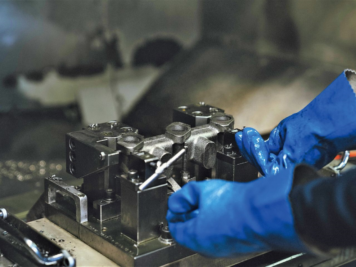
Enatech Corporation specialises in the mass production of cast materials such as cast iron and aluminium die-castings. It handles over 800 unique, complex shapes each month. This capability stems from its jig design expertise. Specific jigs are prepared for each individual product. Furthermore, cast materials typically have tolerances of around ±1mm, and many design elements cannot be fully understood from drawings alone. Preparing jigs for mass production machining typically requires several months. However, Enatech Corporation handles jig design and assembly entirely in-house, enabling preparation in as little as one week.
Some jigs are supplied externally, contributing to the manufacturing processes of other companies facing similar challenges, such as handling complex-shaped components. In this way, the company's specialised technology directly contributes to creating new added value.
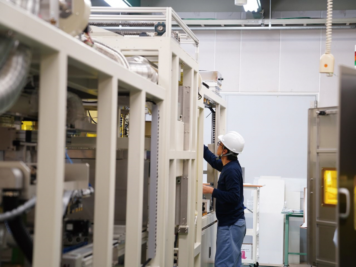
The MS Division holds numerous patents, including the world's first printed circuit board edge coating system. Its coating technology, in particular, establishes an environment capable of applying liquid agents with consistent quality through various condition settings such as roller shape, feed speed, and liquid agent properties. This enables film thickness control at the 1μm level. As of 2025, only three companies worldwide possess this substrate coating technology, with the company being the sole provider capable of handling contact-type coating. Starting from solving on-site challenges, the company systematically develops core technologies centred on labour-saving and automation. This approach drives the development of next-generation equipment.
代表者顔写真-1-165x165.png)