Contact Us
Stable supply of high-quality moulded parts through moulding condition management and visual inspection
Machining & Processing
We accept orders from companies located in Japan.
Updated: March 13, 2026

2025
Updated: March 13, 2026
2025
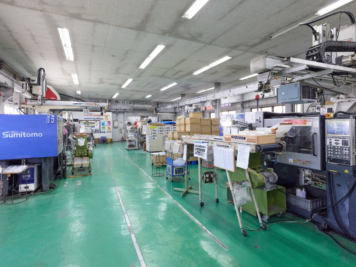
N ENGINEERING specialises in injection moulding for various plastic products. The company possesses mould clamping forces ranging from 50 to 130 tonnes and specialises in moulding small, complex-shaped components. It has a particularly strong reputation for moulding products requiring high dimensional accuracy and beautiful surface finish, such as those for home appliances and automobiles. Furthermore, alongside developing high-precision prototypes using 3D printers, it actively accepts moulds transferred from other companies and proposes maintenance solutions, thereby supporting customers' stable mass production.
N ENGINEERING advanced moulding technology enables the production of compact, complex-shaped components smaller than the palm of the hand.
The company has previously handled the moulding of micro-components measuring 5mm and products with dimensional tolerances at the 0.001mm level. We met these stringent requirements without defects by adjusting resin injection volume in 0.01mm increments, controlling injection speed in 0.1mm/sec increments, and implementing advanced moulding condition management based on MFR (a resin flowability indicator). Furthermore, we ensure the supply of flawless, beautiful moulded parts free from fingerprints or scratches through robotic part removal, 3D measurement equipment, and visual inspection. In recent years, many home appliances feature glossy finishes, demanding stringent appearance quality. This approach to manufacturing by N ENGINEERING is why it is supported by the home appliance industry. Similarly, high precision is required for prototype development of mass-produced items with strict dimensional tolerances. Therefore, prototyping is carried out using 3D printers capable of high-precision modelling, adding depth to the company's moulding technology.
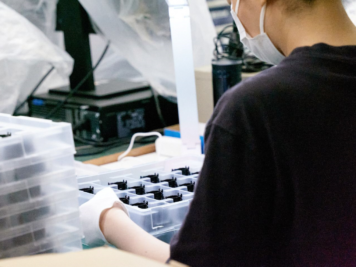
At N ENGINEERING the inspection process accommodates 100% visual inspection in the inspection room. For home appliance components involving secondary processing such as painting or printing, defects include not only scratches and dirt but also fingerprints and cloudiness. However, camera inspection can sometimes fail to identify acceptable products due to halation caused by lighting effects. Therefore, conducting a full visual inspection by inspectors ensures the reliable elimination of minute defects that are difficult to detect by camera inspection. Although this process is labour-intensive and time-consuming, it is considered a necessary step to maintain high quality.
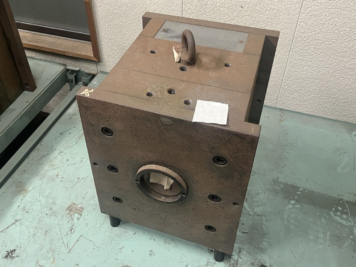
N ENGINEERING actively accepts the TRANSFER TYPE mouldst from other companies that have ceased operations. For customers wishing to continue mass production using existing moulds, we diagnose the mould's “health status” – including wear and precision degradation – and verify the presence of moulding defects such as burrs, scratches, and sink marks through moulding trials. We then advise on the feasibility of stable mass production. Where necessary, we propose optimal mould repairs or replacements aligned with the customer's production schedule. Moving forward, we will also pursue in-house mould maintenance to deepen our understanding of moulds.