Contact Us
Confidence in our on-site capability to transform customer aspirations into tangible form
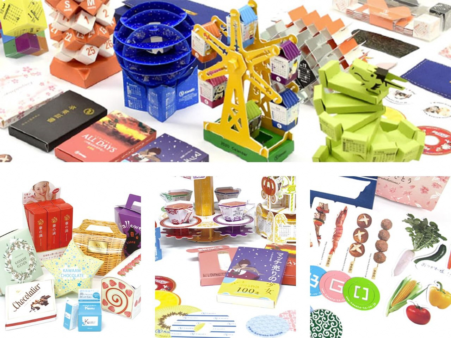
Packaging, Printing & Textiles
We accept orders from companies located in Japan.
Updated: March 13, 2026

2025
Updated: March 13, 2026
2025
Kawata Shiko has consistently handled the planning, manufacturing, and processing of paper products, primarily packaging, for over 70 years since its founding. It produces complex shapes and special specification packaging through techniques such as manual ‘menkiri(edge trimming)’ by on-site workers and ‘nanameori(diagonal folding)’ using proprietary auxiliary components. It tackles challenges deemed difficult by other companies through on-site capability and ingenuity.
Furthermore, the company flexibly accommodates large-format die-cutting up to A-size (900×1,200 mm), as well as diverse product varieties, small batches, and short lead times.
While packaging fundamentally aims to protect goods, it also serves as a bridge connecting products to consumers. The company places great importance on transforming customers' sentiments towards their products into tangible forms through design and functionality. It has earned customer trust by creating packaging that adds value to products.
Kawata Shiko values the dedication of those pursuing better manufacturing, the strength of its production teams, and the confidence and pride in meeting the demands of high-difficulty packaging production. For over 70 years since its founding, it has continuously taken on numerous challenges through accumulated experience and unique processing expertise.
The packaging processing stages comprise three steps: die-cutting, separation, and assembly. Technical skill shines through in each. During die-cutting, manual “edge trimming” meticulously adjusts the thickness and depth of guide lines. This achieves both precision and high-quality finish while enabling responsiveness to diverse product types, small batches, and tight deadlines. Furthermore, our Thomson machines, capable of handling large A-size formats, accommodate poster sizes and other dimensions difficult for competitors.
For pasting, we achieve the challenging ‘diagonal folding’ process – difficult with standard gluing machines – by designing and manufacturing specialised auxiliary components. Such modifications to existing equipment enable us to handle complex shapes and tackle highly demanding projects.
Furthermore, the company takes pride in its proposal capabilities, underpinned by this on-site expertise. From the product planning stage, we attentively listen to the customer's vision, collaboratively explore shapes and specifications, and deliver optimal proposals that consider both cost and usability.Thus, the dual strengths of on-site technical capability and proposal expertise enable the company to provide manufacturing that truly aligns with the customer's needs – this is its distinctive appeal.
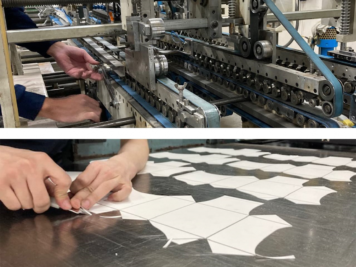
Kawada Shiko employs manual ‘surface trimming’ by on-site technicians for die-cutting. Typically, adjustments are made using ‘surface plates’ based on CAD data. However, Kawada Shiko's skilled on-site operators manually fine-tune the thickness and depth of guide lines for each product. This enables the company to achieve both precision and finish quality while accommodating diverse product types, small batches, and short lead times. Furthermore, in laminating processes, the use of specialised auxiliary components enables the ‘diagonal folding’ operation. Such ingenuity from on-site technicians forms a strong operational capability, allowing us to process and deliver products exactly as the customer desires, even for projects unfeasible for other companies.
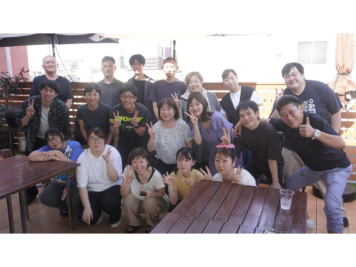
Kawata Shiko has a guiding principle of ‘Always feel, always think!’ to realise its vision of ‘365 days of smiles!’. This embodies the importance of not merely completing tasks, but cultivating an attitude of noticing, thinking, and growing within daily work. This forms the fundamental attitude of its employees. Furthermore, all employees participate in three committee activities, promoting initiatives such as ‘creating a workplace where we realise a sense of fulfilment together’ and ‘efforts that lead to employee growth’. These committee activities function as a cross-functional mechanism within the company, driving transformation beyond routine operations towards the company's desired future state.