Contact Us
Contributing to the 3Rs(Reduce・Reuse・Recycle) through air handling expertise and equipment development
Machinery & Equipment
We accept orders from companies located in Japan.
Updated: March 31, 2026
2025
Updated: March 31, 2026
2025
TATSUMI AIR ENGINEERING specialises in the development and design of various apparatus and equipment, primarily focusing on air-powered conveying, separation, recovery, and dust collection. The company commenced operations by supplying the spinning industry, subsequently expanding into the paper, sanitary materials, and printing sectors, and has now broadened its market reach into the automotive components industry. In recent years, it has also concentrated on developing equipment for the recycling of recovered materials. The company has developed equipment such as PET bottle recycling systems and volume reduction devices for shredder waste. Leveraging its advanced air-based technologies, it offers solutions aligned with the 3Rs (Reduce, Reuse, Recycle). Against the backdrop of heightened interest in the SDGs since the late 2010s, its presence has grown significantly.
TATSUMI AIR ENGINEERING celebrated its 50th anniversary in 2025. Throughout its history, the company has consistently developed proprietary air-handling technologies through the design and development of equipment utilising air as a medium, securing approximately 80 patents. In 2023, it established ‘AIR LABO’ as a new R&D facility to further refine these technologies.
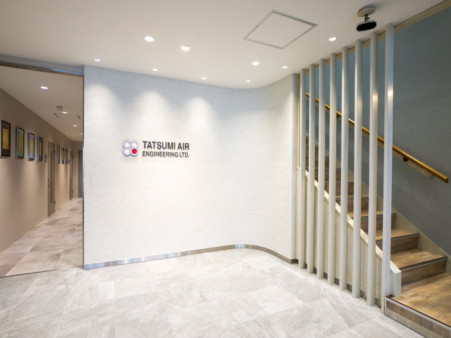
AIR LABO was established to enable immediate demonstration testing of equipment and facilities, responding to the increasing complexity of recovery and separation processes related to the 3Rs (Reduce, Reuse, Recycle). The facility houses the company's own separation and recovery equipment, around which planning and design are centred. Where necessary, products and equipment from other companies are integrated to conduct demonstration tests. TATSUMI AIR ENGINEERING conducts these tests using materials provided by customers, verifying performance by modifying or altering combinations of equipment and facilities. Through these demonstration tests, the facility contributes to the development of new equipment and the exploration of new markets. Examples include the ‘SPC System (SAP/PULP Recovery Equipment)’ for separating SAP (superabsorbent polymer) and pulp from disposable nappies, and the ‘Impact Blower (Material Separation Device)’. This facility is crucial for further advancing TATSUMI AIR ENGINEERING's technological capabilities.
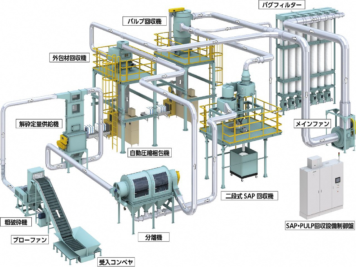
The SPC System is equipment that decomposes waste generated during the manufacturing process of disposable nappies, recovering SAP and pulp at high purity. Recovery processing is carried out via the following process. First, collected waste is fed from the receiving conveyor into a coarse pulveriser, where it undergoes coarse crushing and processing. It is then finely pulverised and quantitatively conveyed by a pulverising and metering feeder. Next, a separator precisely separates the outer packaging material from the pulp. The outer packaging material, SAP, and pulp are then recovered by their respective dedicated recovery machines. The two-stage SAP recovery machine enables high-purity recovery of the absorbent. The pulp recovered with the SAP is then separated from the conveying air and recovered by the pulp recovery machine. The conveying air passes through a bag filter to remove fine dust, is recirculated within the equipment, and becomes purified exhaust air. This equipment is designed with environmental considerations in mind.
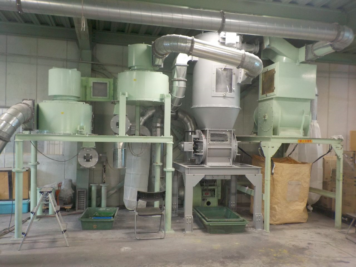
The impact blower can separate and recover materials composed of fibres and resin in a composite form. Processing is carried out through the following steps. First, the impact blower device delaminates the resin layer without damaging the fibres, then pulverises the resin solids to a reusable particle size. Next, the material, sucked in and conveyed by a high-pressure fan, is processed through multiple impacts by saw-shaped grinding blades. Subsequently, fibres and resin are separated with high precision through an air separation process utilising density differences and a defibration process. This treatment method achieves 100% resin reuse. It enables the separation and recovery of automotive interior materials such as tile carpets, mats, soundproofing materials, and ceilings. This constitutes next-generation recycling equipment compatible with the circular economy.